Plus Plus Calibration delivers precision Ferrari ECU tuning for owners across the United States. From the twin-turbo V8 488 and F8 Tributo to the hybrid SF90 Stradale and 296 GTB, our shop calibrations are developed and verified in-house on our dyno, with full data logging and before-and-after documentation for every car that leaves. Stage 1 and Stage 2 tunes for the 458, 488, F8, SF90, F12 and 812 can also be ordered online.
A short history of Ferrari performance
Ferrari built its first car bearing the Ferrari name, the 125 S, in 1947, and racing has shaped its road cars ever since. For decades its mid-engine V8s were naturally aspirated, ending with the 458 Italia and its 4.5-liter V8.
In 2015 the 488 GTB brought turbocharging back to the mid-engine V8 with a 3.9-liter twin-turbo engine, the basis of the F8 Tributo that followed in 2019. The same year, the SF90 Stradale added a plug-in hybrid system with three electric motors, while the front-engined 812 Superfast carried on with a naturally aspirated 6.5-liter V12. Naturally aspirated, twin-turbo and hybrid: that range is why every Ferrari calibration starts from the specific engine in front of us.
Ferrari platforms we tune
Our Ferrari calibration work covers the modern V8 and V12 range:
- 458 Italia, 458 Spider, 458 Speciale and Speciale Aperta — naturally aspirated 4.5-liter V8, the last of the pre-turbo era.
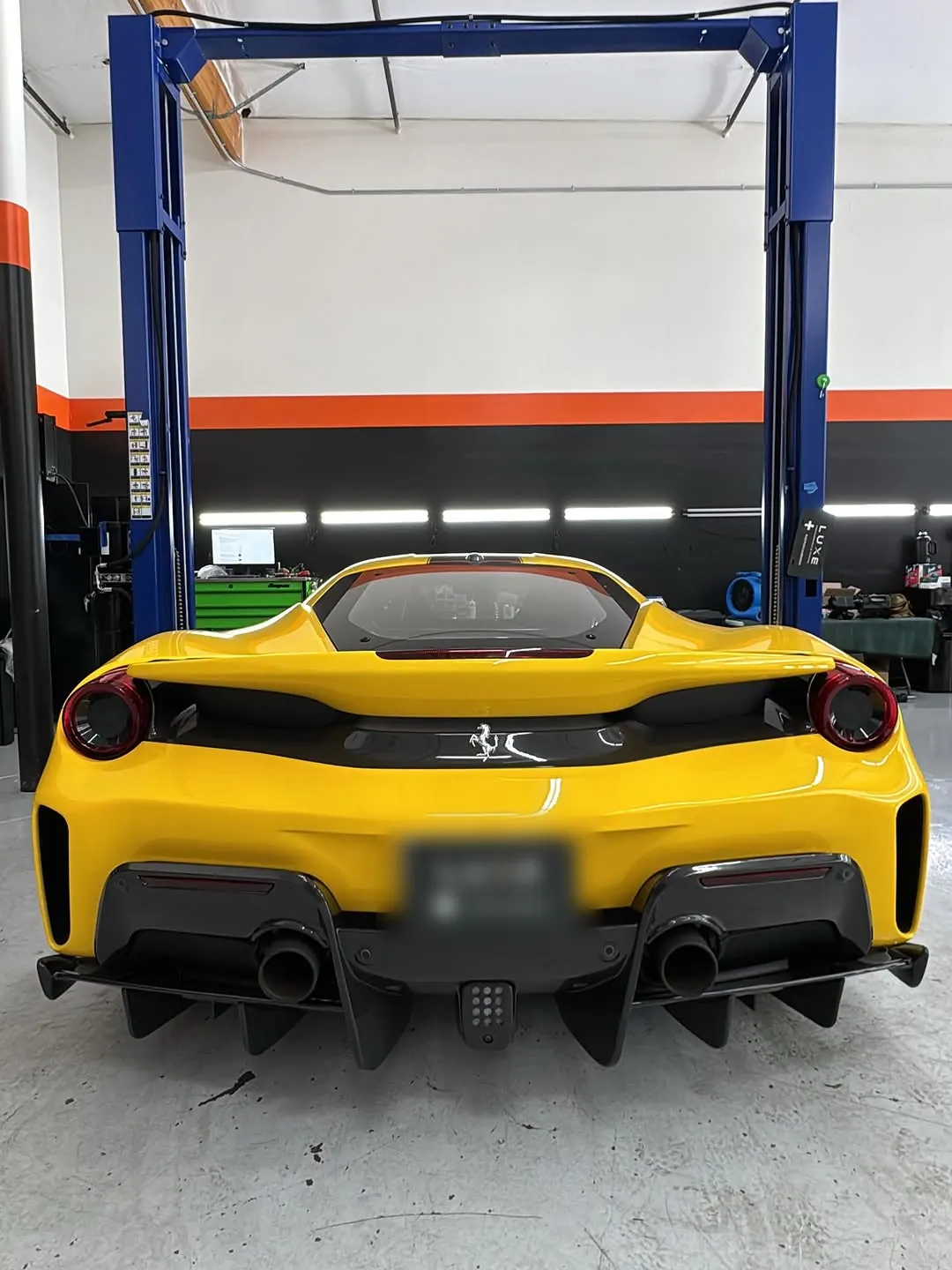
- 488 GTB, 488 Spider, 488 Pista and Pista Spider — twin-turbo 3.9-liter V8. A strong tuning platform with substantial Stage 1 gains.
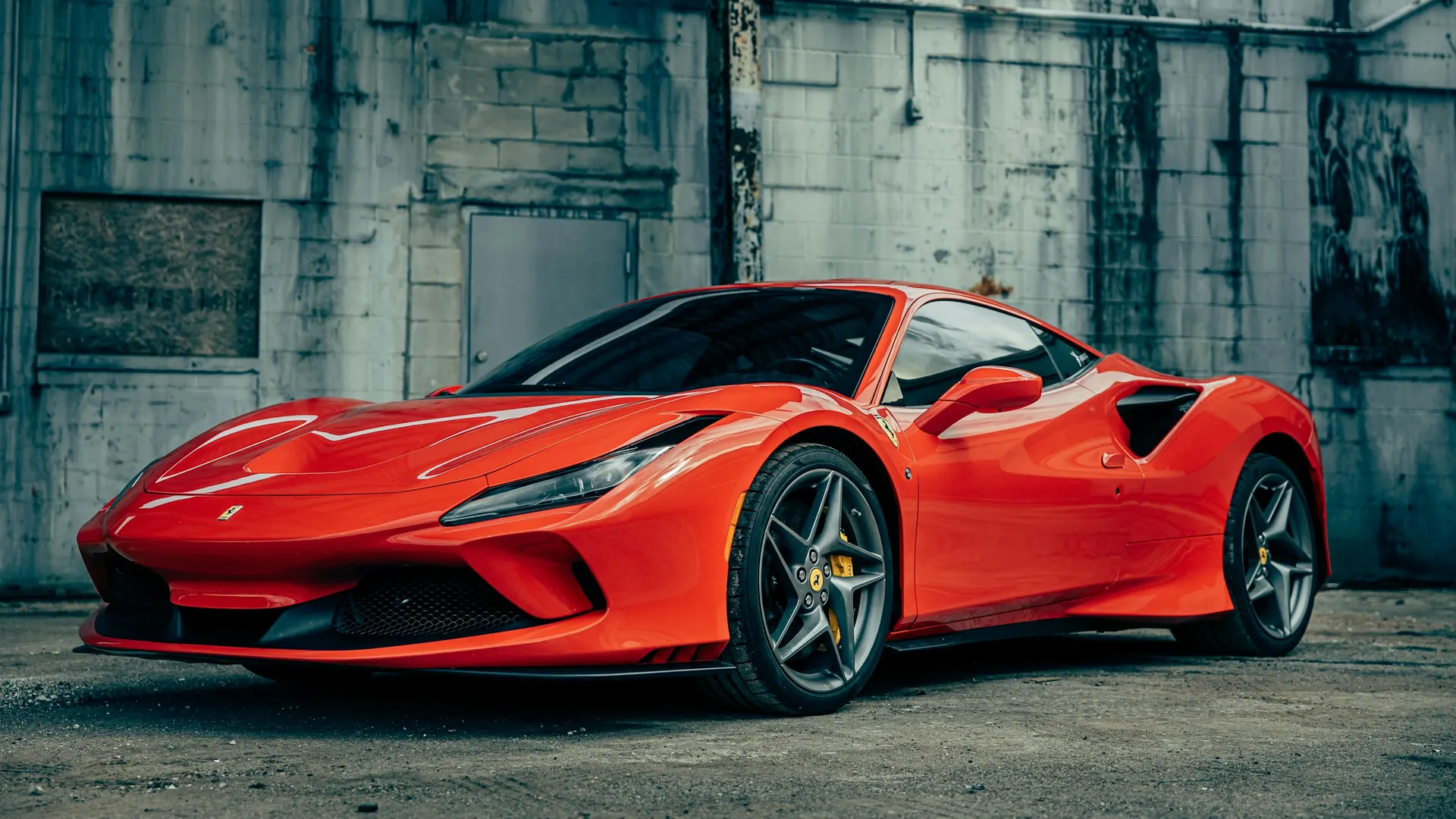
- F8 Tributo and F8 Spider — the refined twin-turbo V8, with calibration behavior similar to the 488 and slightly different ECU addressing.
- SF90 Stradale and SF90 Spider — twin-turbo V8 plus three electric motors. The hybrid platform needs a specialized calibration approach.
- 296 GTB and 296 GTS — twin-turbo V6 plug-in hybrid. A newer platform with developing calibration support.
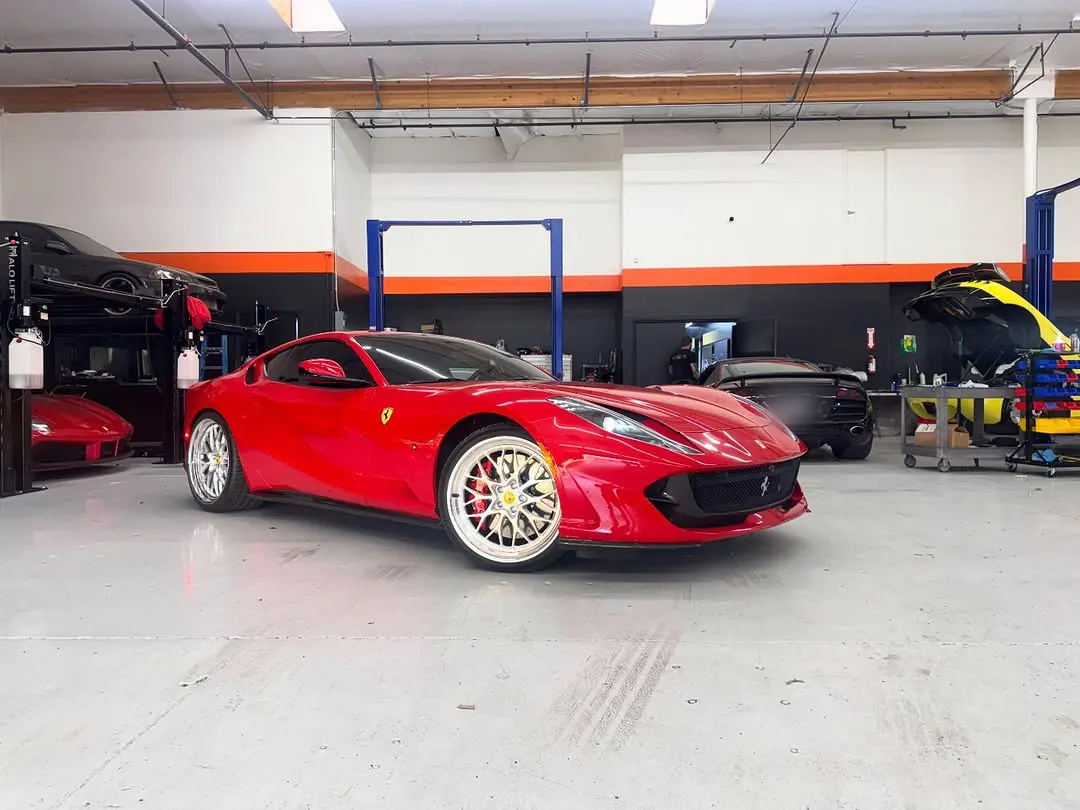
- 812 Superfast, 812 GTS and 812 Competizione — naturally aspirated 6.5-liter V12, where calibration focuses on throttle response and cam timing.
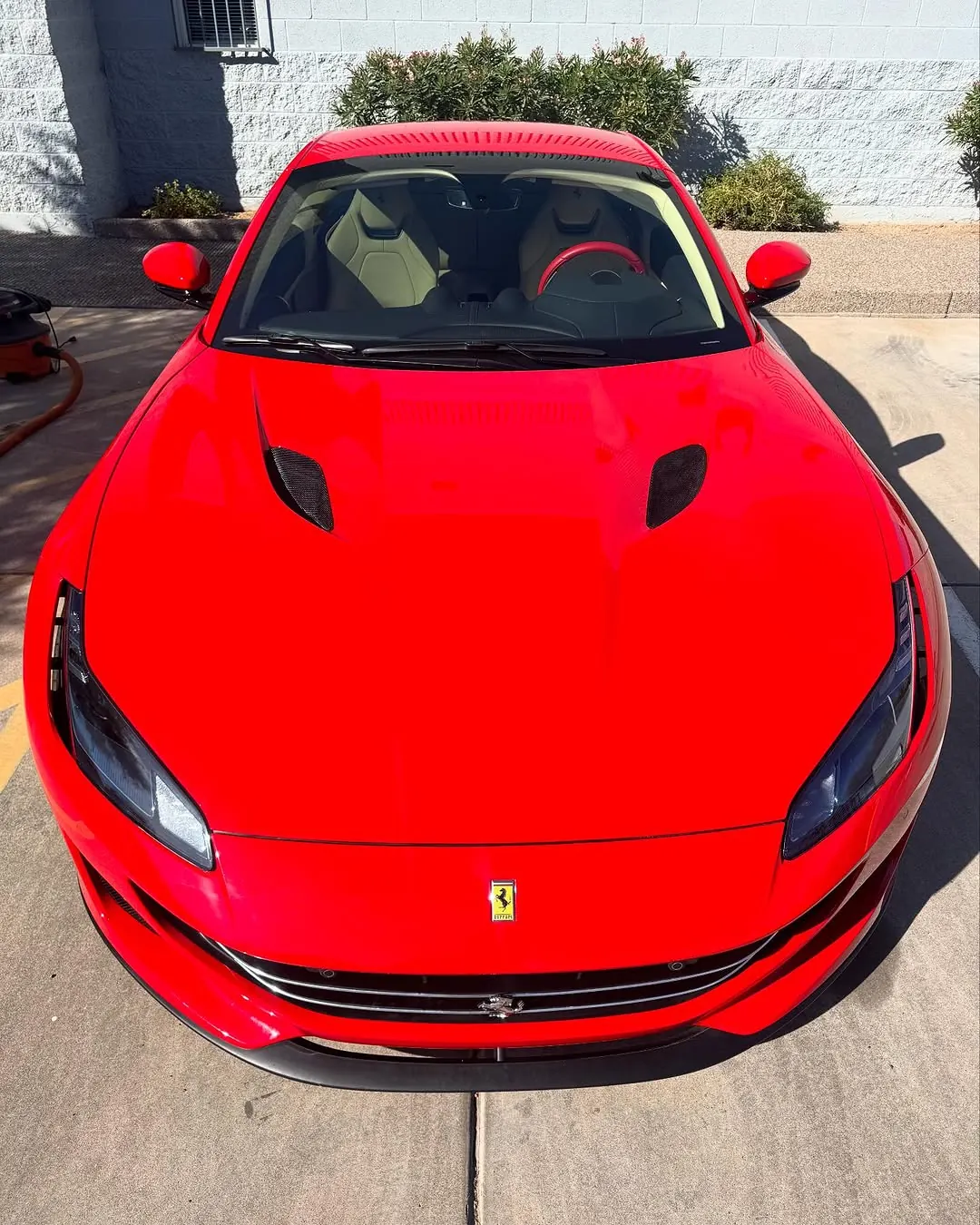
- Roma, Roma Spider and Portofino M — twin-turbo V8 grand tourers.
- Purosangue — naturally aspirated V12 SUV. An early platform with limited calibration scope.
458 Italia and 458 Speciale naturally aspirated V8 tuning
The 458 platform (2010–2015) is Ferrari’s final naturally aspirated mid-engine V8 and a very different calibration discipline from the twin-turbo 488 that replaced it. There is no boost or turbocharger headroom to exploit, so 458 ECU work focuses on cam phasing, ignition timing, throttle mapping and rev-limit refinement. The character change is significant: sharper throttle response, a more aggressive cam at upper RPM, and a willingness to pull harder past 8,000 rpm.
The 458 Speciale and Speciale Aperta ship with a more aggressive factory calibration than the base car — roughly 597 hp against 562 — but the same tuning principles apply. Our catalog lists a 2015 458 at 625 hp at Stage 2, from 570 hp stock, and combined with an aftermarket exhaust the platform comes alive.
488 and F8 Tributo Stage 1 tune
The 488 and F8 Tributo share the same 3.9-liter twin-turbocharged V8, a platform Ferrari engineered with substantial headroom above stock. Our Stage 1 ECU calibration raises boost targets from the factory’s conservative setpoints and optimizes ignition timing on pump 91 octane, with the most dramatic gains in the mid-range between 3,000 and 5,500 rpm, where the factory calibration is most conservative.
In our online catalog, a 2024 F8 goes from 710 hp to 830 hp at Stage 1.
488 and F8 Stage 2 tune with bolt-ons
Stage 2 is where the 488 and F8 reveal their true potential. With high-flow downpipes (cat-less or high-flow cat), a high-flow intake and, in some cases, upgraded intercoolers, our catalog lists the 2024 F8 at 900 hp at Stage 2 on stock turbochargers. Stage 2 builds done in our shop also benefit from an E85 or high-octane race-fuel calibration for maximum power.
SF90 Stradale hybrid tuning
The SF90’s twin-turbo V8 and three-motor hybrid architecture needs a fundamentally different calibration approach from a pure combustion platform. The electric motors supply substantial torque at low RPM, which changes how the engine’s calibration should be shaped. Our SF90 work focuses on optimizing the engine calibration — boost, timing and fueling — while respecting the hybrid powertrain’s torque distribution logic.
296 GTB V6 hybrid calibration
The 296 GTB’s 120-degree twin-turbo V6 is one of the most interesting engines in the modern Ferrari range. As a newer platform, our calibration support is actively developing; we tune the 296 GTB and GTS in our shop, with gains similar in character to the 488 — meaningful mid-range torque and sharper throttle response. The plug-in hybrid’s pure-electric mode is untouched; all calibration work focuses on the V6.
812 Superfast V12 calibration
Naturally aspirated V12 tuning is a different discipline from forced-induction work. On the 812 Superfast, 812 GTS and 812 Competizione, we focus on rev limit, cam phasing, throttle mapping and fuel and timing optimization. The 812 pulls harder to its 8,900 rpm redline, responds more crisply to the throttle and makes more mid-range torque.
Our catalog lists a 2023 812 Superfast at 860 hp at Stage 1 and 915 hp at Stage 2, from 789 hp stock.
What Ferrari owners get in our shop
Every Ferrari we tune in our shop leaves with baseline and tuned dyno sheets, a complete data log showing air-fuel ratios, knock counts, boost pressure and exhaust gas temperatures, a written summary of every calibration change, and a short road drive to validate drivability. Most Stage 1 tunes are completed in a single day, and for out-of-town clients — many Ferrari owners travel from California, Texas and Colorado — we coordinate lodging and transportation in north Phoenix.